fincarna

Integration is usually the reason these projects take years

Connekt is the reason this one does not. Your file format becomes a pipeline you build in a designer, not a bespoke integration somebody has to own forever.

The challenge

A pricing platform cannot price anything until it holds the data your core already keeps: the customers, the accounts, the balances, the daily events. That data arrives the way bank data has always arrived. A zip lands on a schedule. Inside are fixed width files, or delimited files with a trailer record holding a control count, possibly encrypted, with dates in a format that made sense to someone in 1998.

Historically every institution onboarded means a new integration project. Somebody writes the parser. Somebody else maintains it. A column moves and it breaks in production at two in the morning. This is the single biggest reason pricing platform implementations are quoted in years rather than weeks, and it is why so many of them stall before going live.

The generic answer to this is an ETL tool. But a general purpose ETL tool that can run arbitrary queries and call arbitrary endpoints is exactly the thing a bank’s security review is designed to stop, and rightly so.
How Fincarna solves it

Connekt is a pipeline designer with a palette built specifically for bank data. Steps are business operations rather than infrastructure primitives. Unpack the archive, decrypt it, verify the control totals, route each file to its own branch, normalise the dates and amounts, and map each record onto the Fincarna account and product variant it belongs to. Your core's flat account gains the billing configuration it never had.

Because the steps are named operations rather than arbitrary code, the pipeline is something a security reviewer can actually read, and there is no path for a pipeline author to reach data they should not have. No step runs a raw query, and no step can be pointed at an endpoint to move data off to the side. When you do want to hear about something as it happens, that is what webhooks are for: a declared subscription to the events you choose, delivered to an endpoint you register, rather than an outbound call buried inside a pipeline.

Connekt also does not reach into your core to pull data. You push data out to us and you pull results back, because banks do not let an outside system dial into their network, and we did not build one that needs to.

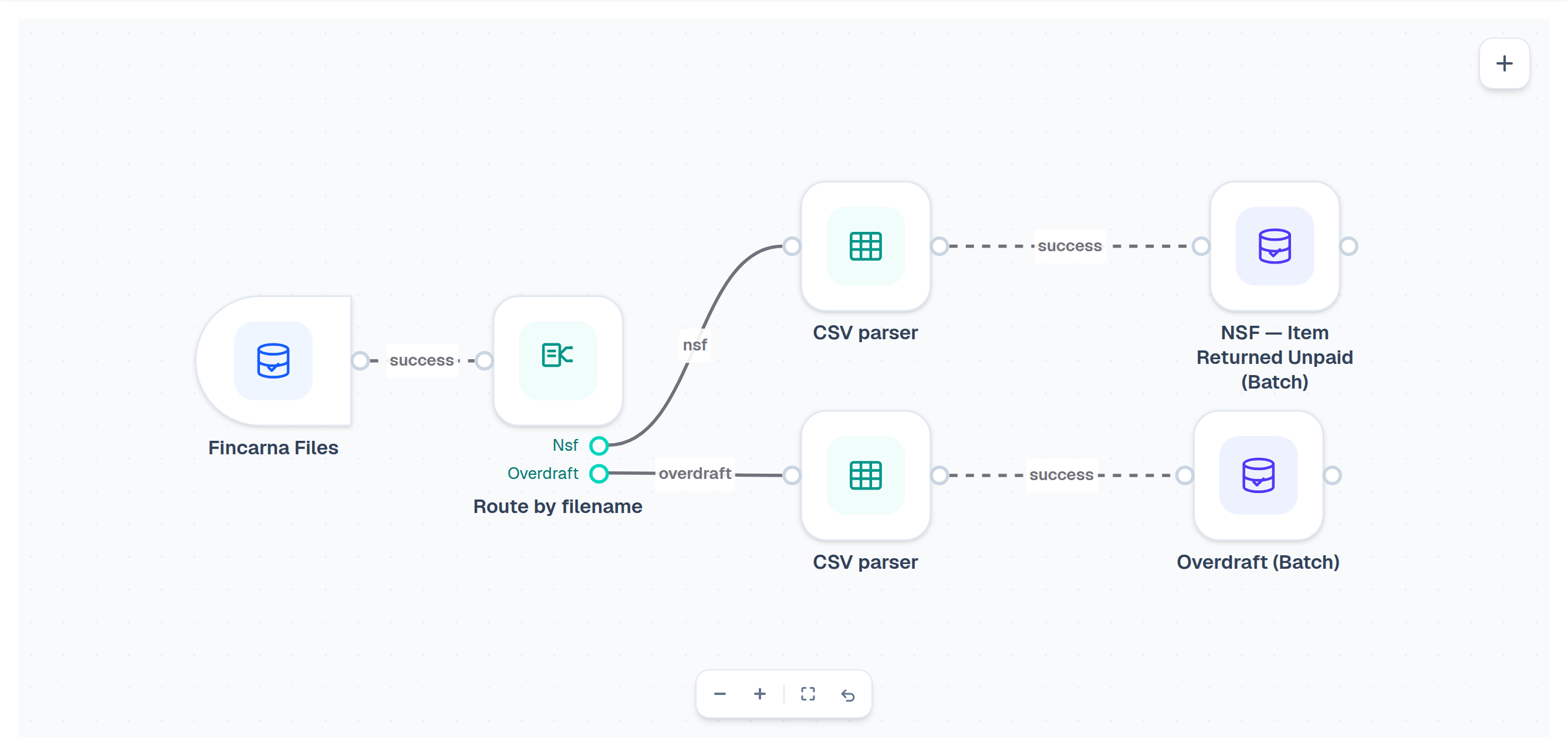
The Connekt pipeline designer showing a bank file source routed by filename into two branches, each parsed as CSV and written to a batch sink for NSF and overdraft events
A real pipeline, built on a canvas rather than in code. The bank drops a file, Connekt routes each one to its own branch by filename, parses it, and writes to the sink that matches your catalog.

What runs through it

01

Day zero load

Customers, accounts, balances

Bring your existing book across in one pass. Upload individual files or a single bundle. Rows that fail validation are isolated with a readable reason rather than failing the whole load, and you fix and retry only what broke.

02

Nightly batch

However your core exports

Most cores produce a nightly drop. Connekt takes the zip as it comes, verifies the checksum and control records, unpacks it, and routes each file to its own branch. You do not reshape your export to suit us.

03

Real time events

As they happen

Where your systems can push events in real time, they can. The same pipeline model covers both, and both land in the same place with the same guarantees.

04

Billing output back out

Invoices and rates

Integration runs both directions. Completed billing output is extracted, mapped to the column names your downstream systems expect, and written back out for pickup on your schedule.

From initial load to daily operations

Day 0

Initial setup

Load your existing customers, accounts, and opening balances. Upload individual files or a single zipped bundle, and Fincarna processes them in the right order. Rows that fail validation are isolated with a reason. Fix and retry those rows without re-uploading the file.

Customers, with custom attributes
Accounts, mapped to product variants
Opening balances

Day to day

Ongoing operations

Send billing events as they happen or in nightly batch files. Update balances, add new accounts as they open. Fincarna processes events against your pricing rules and produces billing outcomes on your configured cycle.

Billing events: transactions, usage, service activity
Balance updates, daily or on change
New accounts and customer changes

Key capabilities

A designer, not an ETL project

Pipelines are built on a canvas from a palette of banking shaped steps. Unpack an archive, verify a trailer record, normalise a date format, route on a filename, map a field. The bank’s file format becomes a configuration rather than a piece of bespoke code that somebody has to maintain.

Steps that know what a bank file looks like

Fixed width layouts, PGP encryption, header and trailer control counts, checksum verification, implied decimals and sign conventions, and the half dozen date formats cores actually emit. These are palette items, not things you write yourself.

A bad row fails the row

One malformed record does not reject the file. It is isolated with a readable reason, surfaced in the dashboard, corrected in place by an operator, and the batch resumes from where it stopped.

The same event cannot be billed twice

Deduplication runs at four levels: the same object notified again, the same content under a new filename, the same row restaged after a retry, and the same economic event arriving through a different file. Retries and replays are safe by construction.

Nothing reaches into your core

Connekt never dials into the bank to pull data. You push data out and you pull data back, so there is no inbound path into your systems to approve. The notifications that go the other way are webhooks, delivered outbound to an endpoint you register.

No arbitrary code in the pipeline

There is deliberately no step that runs a raw query or makes an outbound call of its own. Every step is a named business operation, which keeps least privilege intact and makes the pipeline itself something an auditor can read.

Built to run in production

Both ways
Inbound and outbound

Bank data in, billing output back out, through the same pipeline model

Row level
Error handling

Failures isolate, get corrected in the dashboard, and the batch resumes

Four layers
Deduplication

Object, content, staging row, and economic event

SDKs and developer tools

Where you would rather integrate in code than in the designer, every runtime operation is available through the API.

SDKs

Java SDK

Spring Boot, Micronaut, any JVM. Maven Central.

JavaScript and TypeScript SDK

Node.js, serverless, custom tooling. npm.

Python SDK

Data engineering, analytics, scripting. PyPI.

Developer tools

OpenAPI 3.0 spec

Full API spec for code generation, testing, and docs.

Sandbox environment

Fully functional test instance with sample data.

Webhooks

Subscribe to billing events, lifecycle changes, and alerts, delivered outbound to an endpoint you register.

Send us a sample file

Redact it first. We will show you the pipeline that reads it, and you will have a realistic answer on integration effort rather than an estimate.

or email us at hello@fincarna.com